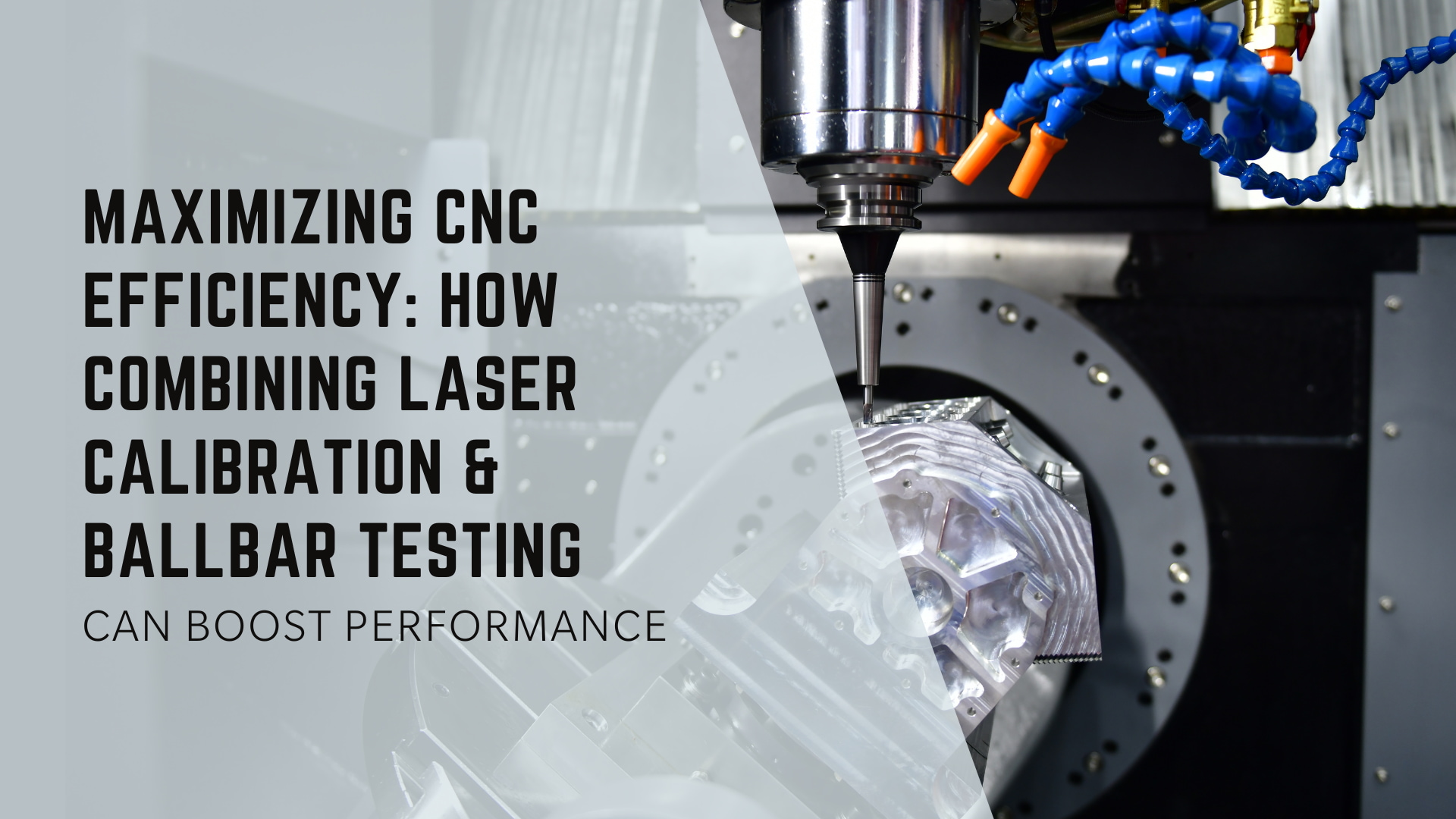
CNC machines are often used in the modern industrial world. From planes to small auto parts, CNC machines are making the individual parts used in their respective industries with extremely tight tolerances and very high quality. CNC machine calibration and performance must be constantly maintained in order to operate these machines to their maximum potential. One of the most effective ways to constantly maintain CNC machine performance is Laser Calibration and the Ballbar Test.
Laser Calibration and the Ballbar Test are both valuable tools that can be used to increase the accuracy of CNC machines, decrease downtime, and improve the surface finish of the parts that CNC machines are producing. In this article, we will take a look at how both these tests can be used together for better results.
Laser Calibration can be defined as a technique that measures and corrects the movement and positioning errors that are present on CNC machines. A laser system is used to calibrate the movements of a CNC machine and measure the movement of the machine’s axes. The main focus of laser calibration is the linear positioning errors, backlash, squareness, and angular errors.
CNC machines that are calibrated using the Laser Calibration method can reach micron-level accuracy, which results in better surface finish, less part rejection and machining optimization. Industries such as aerospace, medical, and automotive are some of the major industries that use the Laser Calibration technique for their machining needs.
A Ballbar Test is another diagnostic tool used to measure circular interpolation errors on CNC machines. This test checks for servo mismatch, backlash, and other related errors to the circular interpolation error. The machine is set up with a ballbar to carry out the circular movement. The data from the ballbar is analyzed and used to determine deviations from the circular movement, errors, or other mechanical issues.
As with the laser calibration, the data collected from a Ballbar Test can help give better insights into the CNC machine’s performance. This way, it is possible to perform predictive maintenance by being able to predict when and where issues will occur. As a result, there are fewer errors, leading to a better precision rate in CNC machine performance.
Although both laser calibration and ballbar testing offer significant advantages on their own, when used together, the results are even more impressive. Let’s take a look at how the two calibration tools work together to provide an efficient CNC machining process:
Improved Precision:
Perhaps the most apparent advantage of performing both Laser Calibration and Ballbar Testing is improved precision. Laser Calibration works to correct both linear and angular errors, while the Ballbar Test addresses circular interpolation accuracy. By using both tools in tandem, manufacturers can ensure that their CNC machines are running at their peak level of precision in all axes and motion types.
Reduced Downtime:
Regular calibration and testing allow manufacturers to quickly identify and correct machine errors before they become larger problems. Unplanned downtime is one of the leading causes of productivity loss in the manufacturing industry. By using both Laser Calibration and the Ballbar Test, companies can significantly reduce unplanned downtime. This also leads to more consistent production schedules and on-time deliveries.
Enhanced Surface Finish:
Achieving a high-quality surface finish is one of the most critical aspects of CNC machining. Both linear and circular errors can contribute to a poor surface finish on the machined parts. By ensuring regular calibration and testing, manufacturers can ensure that their machines are running accurately. This helps to produce smoother surfaces with fewer defects, resulting in better-quality end products.
Increased Machine Lifespan:
Regular calibration and testing also help to ensure that CNC machines are always operating within their optimal parameters. By identifying and correcting errors before they become more significant, manufacturers can help to reduce the wear and tear on essential machine components. This not only extends the lifespan of CNC machines but also reduces the total cost of ownership.
Higher Throughput and Efficiency:
Finally, by maximizing CNC efficiency through regular calibration and testing, manufacturers can increase the throughput of their operations. This means that parts can be produced more quickly, resources are utilized more efficiently, and overall productivity is increased. The combination of accurate machining and reduced errors also means that every part produced will meet the required specifications without the need for rework.
Let’s examine how the two work together:
Laser Calibration
First, the Laser Calibration process is performed to ensure that the machine’s axes are all squared up and moving at the right angles. This way, the machine will be capable of making precise movements and parts.
Ballbar Test
The next step is the Ballbar Test, which is done to determine the CNC machine’s circular interpolation accuracy. This test will identify issues such as servo mismatch or backlash, which can affect the surface finish and accuracy of the machine.
By using both methods, manufacturers can ensure that the machine is operating at peak performance for both straight-line and circular movements, covering all aspects of CNC machine performance.
Combining Laser Calibration and the Ballbar Test can help different industries in different ways. Let’s take a look:
Aerospace:
Precision is of utmost importance in the aerospace industry, where even the smallest error can have disastrous consequences. By using Laser Calibration and Ballbar Testing, aerospace manufacturers can be sure that their CNC machines are up to the task of producing parts that meet stringent tolerances.
Automotive:
The automotive industry also relies on high-quality standards to ensure the performance and safety of its products. By regularly performing Laser Calibration and Ballbar Testing, automotive manufacturers can increase the overall surface finish and precision of automotive parts.
Medical Devices:
Precision and reliability are crucial for medical device manufacturers. By using both diagnostic methods, they can be sure that their CNC machines used in producing medical devices can meet the high industry standards for quality and precision.
As you can see, a combination of both Laser Calibration and the Ballbar Test can help improve performance and quality for manufacturers in a variety of industries.
How often should I do Laser Calibration and Ballbar Testing on my CNC machine?
It is recommended to perform Laser Calibration and Ballbar Testing at least every 6 months or after any major changes or adjustments to the machine. For critical applications or where high precision is required, it may be necessary to perform these tests more frequently.
Can I use Laser Calibration and the Ballbar Test on all types of CNC machines?
Yes, both Laser Calibration and the Ballbar Test can be used on a variety of CNC machines, including vertical machining centers (VMCs), horizontal machining centers (HMCs), and multi-axis machines. They are suitable for any machine that requires high accuracy.
Will the combination of Laser Calibration and the Ballbar Test help improve CNC machine performance for high-volume production?
Absolutely! Regular Laser Calibration and Ballbar Testing will help to ensure your CNC machines are operating at their best and are therefore ready to handle high-volume production. The combination of these methods will also help to reduce errors and improve throughput, ensuring consistent quality across large production runs.
How can Laser Calibration help me improve surface finish?
Laser Calibration helps to ensure that the machine is operating with minimal error in all axes. This means that there will be less mechanical deviation that could cause imperfections in the surface finish of parts. When used in combination with the Ballbar Test, this can help the machine to not only move in a straight line but also to interpolate circles with the same high level of accuracy, resulting in a better surface finish.
In conclusion, regular monitoring and maintenance of your CNC machines are essential for peak performance. By using a combination of Laser Calibration and the Ballbar Test, you can be sure that your CNC machines are operating with maximum efficiency. This will help to reduce downtime, improve surface finish, and extend the life of the machine. The Ballbar Test and Laser Calibration are essential tools for any CNC machine user, whether in the automotive, aerospace, or medical industries. So why not give your machines the best care possible and use these two diagnostic tools to keep them running smoothly and at their best? At Roots Metrology, we offer these services to businesses of all sizes and across all industries to help them achieve optimal CNC machine performance and manufacturing efficiency.
